 Canon5Dtips Photography is more than words.

In this second part of the review, we are going to look at what are the differences between the various rigs, how they affect their uses and what are their strong points.
To save you from reading a long posts, I have spread this part in three articles.
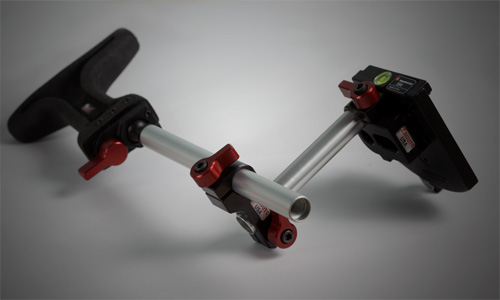
Meet the Rapid Fire
The main strength of the Rapid Fire is that you, as a photographer, don’t need to learn a new way to hold your camera. You still have the left hand on the lens and the other holding the right side of the camera. The Rapid Fire simply adds another point of contact.
If you need to travel light and shoot fast, this is the rig to get. While it is the least stable of the bunch (more on this in the next part of the review), it is the smallest and most compact. Also, by keeping both hands on the camera, you can easily adjust exposure or start/stop recording quickly which results in saving of precious CF card space.
Adjusting the rig
It is so simple, I wont even do a video for this! Just tug the gunstock at the junction of the pectoral and shoulder muscle. Loosen the gunstock adjustment lever a bit and find a comfortable angle while keeping both hands on the camera. Twist the lever and you are set.
Using the rig
The biggest mistake I made when I first got the rig was to assume that pushing the gunstock against my shoulder would be enough to keep it stable. The problem was that I would move my arm while panning or reframing a shot. The movement of the arm would move the shoulder/pectoral muscles which in turn moved the camera. The solution took some times to get used to: instead of moving the camera using your arm, move your whole upper body. All of the action should come from a rotation of the hips, not the arms. This might be obvious to videographers but trust me, it is something totally new for a photographer!
Film like a ninja
Most people who see me shooting in public with this rig think that I am just a photographer using an “original” support device. It is very convenient when the subject might change its behavior if he knew he was being filmed. I have noticed that people are now used to be photographed, but as soon as you say that you are filming, they suddenly change their body language. This rig might help you to solve this issue. It is also useful in places where you can take pictures but not film.
Note
I think that most of the stability problems of this rig are going to be fixed once I get my view z-finder. I will update the post once I receive it to report on the results.