Building a DIY slider: advices

Last week, I decided it was time for me to get back into my workshop and (finally) build a slider using my RigWheels. Right off the bat, I knew this was a prototype; the goal was to figure out the various pitfall of such a project so my next one would be perfect since I would have learned from my mistakes.

The materials

  • 4 sets for RigWheels
  • 8 foot long aluminium tube (1 inch diameter) cut in half
  • 2x 4 foot long wood stick
  • 2 small wood plank and 4 screws

The idea was simple: put the stick inside the tube so I could screw them to the wooden planks. I would then put a camera plate under each wood plank and attach these to a tripod. If I wanted to use the slider directly on the ground, I just had to put the slider upside down. Here is the result. DIY Slider

Comment on the design

My initial idea was to use the slider on the ground, without any tripods. The goal was to use it to shoot clips of my baby girl walking around the house so it had to be at ground level. It is also why I did not mind its ridiculous length: it would give me more room to follow her. For this, it worked perfectly. It stood flat on the ground and only needed a very light push to start sliding.

The mistakes

The problem started when I had the genius idea to use it on a tripod. Because of its length, it required two tripods. I knew a 4 foot long slider was too much but I thought it would be cool nevertheless so I went forward. Big mistake. Half that length would have been much easier to manage, move around and would have been soooo much more stable! Using two tripods also means that it was harder to level the slider and move it around. Moral of the story: never use a six legged slider if you ever plan to move your slider around!

The other issue I had was with the camera center of gravity. Since I was out of ballheads, I borrowed one from my friend. It pushed the camera up about 3 inches on top of the rails. With such a high center of gravity, it was hard to move the slider without generating any shake. If I pushed the slider while holding the camera, the sliding effect would be jerky because wheels would not carry the weight evenly and if I pushed the slider by the base, the camera ran the risk of wiggling.

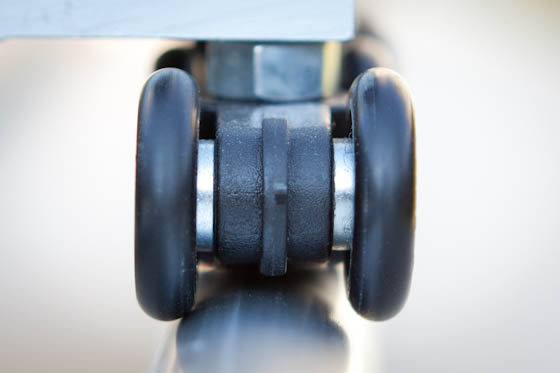
My final issue had to do with my choice of rails (tube). I picked them too small. As you can see in the picture below, not all the wheels are touching the rails at the same time. Surprisingly, this is not that much of an issue regarding the smoothness of the slide, but it does affect the centre of gravity since the camera + head + carriage weight is not evenly distributed.

Next version

Of course there is going to be a next version! But this time I will do the following improvements:

  • Make the slider 24 inches long
  • Spread the rails further apart so I have enough room to put the camera between them to decrease the centre the gravity
  • Use a single tripod design
  • Have the rails about 1/4 inch wider
I will keep you updated once version 2 is out!
DeliciousStumbleUponDiggTwitterFacebookEmail

DIY Alert: RigsWheels are on sale!

To all the DIYers out there, RigWheels is currently having a sale so it may be a good opportuinity to get a set of wheels for your slider. The rebate is around 15%. I have been playing with the RigWheels for a while now and my conclusion is simple: if you want to buildyour own slider BUT value your time, get them! You will save a lot of time trying to find wheels that 1) roll smoothly and 2) are easy to install on your rig. Trust me, I have been there, I have visited all the hardware stores in my area when I was working on my slider and couldn’t find anything half decent.

NOTE

A few people contact me trying to compare these wheels with pro level solutions like the pocket dolly or the Cinevate sliders. Of course these solutions are better, but they are 6x the price so they have to be! The true power of the RigWheels are their flexibility, you can use them to create 10 foot long sliders if you need to, something you can’t do with other pro solution.

DeliciousStumbleUponDiggTwitterFacebookEmail

Almost DIY Ring Flash

My friend Udi from DIY Photography announced today something he has been hinting me about for a while: a DIY Ring Flash where the only thing you have to do is assemble & glue the various parts. No need to look for the perfect components at the store. Udi did the job for you!

If you have ever tried to build your own ring flash, you know how time consuming it can be to get the perfect light. And if you value your time at anything over 5$/hour it should be clear how good this deal is at under 25$! He even made a video to show how easy it is to build:

Udi did not only released the DIY ring flash, he also announced a double flash bracket which look quite cool. Go over and take a look.

DeliciousStumbleUponDiggTwitterFacebookEmail

Can you really get the RigWheel cheaper over the net?

I just received this email from Lance (RigWheel owner) in reply to J.R. Tabotier about places to get cheaper wheels for your rig. I think it is worth sharing this with your guys because too often people diminish the amount of work, testing & research that goes into developing rig part.

I know because I have been there. This is actually the reason why I gave up on the Cable Trigger. To make it worth for me, I had to sale it at a price point that most people would have complained about.

So here is Lance reply:

If he had done a little more research he would have found that www.newyorkmetal.com has a $100 minimum order and and $25 processing for orders under $200. Total shipped price at www.cabinetmakerssupply.com is $138.53; About what I charge for wheels + international shipping. Lastly, it’s similar but not the correct part;)

I have received my set of wheels last week and haven’t had time to build my rig around it. Should come soon enough…

DeliciousStumbleUponDiggTwitterFacebookEmail

RigWheels – the missing part for your DIY Slider project

I just received this video from Lance, one of our reader.

Aren’t these cools? And you want to know the best part? They are actually quite affordable! At 115$ for a set for 4 wheels, they are within the budget of pretty much all videographers.

Here is a sample footage clip.

Slider based on wheels are better than those on rails for various reasons and I can’t wait to get my set to give these a proper review! You can order yours on the official website.

Edit: link to mode RW info about pricing

Edit: added the sample footage clip.

DeliciousStumbleUponDiggTwitterFacebookEmail

DSLR Cinema book contest winner & new contest!

The month is over (I am actually late by a day!) and the contest winner has been picked (will put name once I have his authorization).

The contest was such a success that I decided to repeat the experience for the month of March. This time with a new prize.

The Prize

I will be giving away is the very good ebook DIY studio Photography (review).

How to enter

There are two ways to win:

Either join the HDSLR mailing list by entering your email in the popup window or (if you closed it and do not want to reset your cookies) in the input box on the right column.

OR you can go the Twitter way and follow us (http://twitter.com/canon5dtips) on Twitter. Then retweet this in your timeline:

Enter to win the DSLR Cinema book from Canon5dTips. Pls RT. Info at: http://www.canon5dtips.com/con_2

It is very important to copy/paste the tweet as it is since it is how I am going to find you back!

Duration

I will let this run until the end of the month then randomly pick a winner among the people who respected the entry conditions.

Tip: get on the mailing list, there are other good things to get from having your name there and your odds carry on from one month to the next!

Rules

I really don’t like lawyers so lets just keep them away and say that you can’t enter the contest if you are not allowed to do so for what ever the reason based on your location.

DeliciousStumbleUponDiggTwitterFacebookEmail

eBook Review: DIY Home Studio Photography

As most photographer will tell you, if you want to take good portraits, dont invest in lenses, invest in lights! The proof is, even with a crappy iPhone camera, it is possible to get pro level pictures if you get awesome lights (proof). The thing is, getting a good set of lights is not cheap, especially when you realize how many modifier you need to satisfy your creativity.

This is where my friend Udi, from DIY Photography, steps in. His popular blog presents various DIY strategies to achieve the pro look using much cheaper DIY alternatives. While his blog usually only presents the end results with a quick description, he recently published an eBook that goes into every single steps of the building process.

You maybe thinking ‘why do I need instructions? Building a softbox is easy‘ and you would be almost right. It is easy once you have done all the mistakes and that is, according to me, the greatest value of the ebook: having someone else figure out the complicated stuff for you.

The book presents the building instructions for:

  • Softboxes
  • Reflectors/Diffusers
  • Light restricters
  • Light supports
  • Ghetto set-ups (I loved the underlight section, great idea!)

As you can see, it covers pretty much anything you may want to build/need.

Are these DIY lights as good as pro ones?

As good, no. Nearly as good? Nearly. The biggest difference between the two is usually in the materials. Pro gear will reflect or diffuse the light better because the manufacturer has access to better materials to manage light. The difference is usually minimal and can often be solved by adjusting the strobe power or zoom level.

Should you get the book?

If you are thinking about building a home studio and you value your time, I strongly suggest you do. It is cheap and will worth many times its price in time saved!

You can get the book here.

DeliciousStumbleUponDiggTwitterFacebookEmail

OSCT bracket [EXCLUSIVE] Pre-order now and save!

I am very happy to announce that I am ready to take pre-orders for the OSCT!

What is it? It is a L shapped bracket that you insert between the camera and the camera plate. You can then attach a cable trigger to the camera to press the SET button to start/stop video recording. This is mostly useful when working with shoulder rigs. Here is a video to explain the whole thing.

Why do you need this?

If you dont own a shoulder rig you dont really need this. On the other hand, if you do own a rig, this is the most useful piece of gear ever! As I say in the video above, it:

  • Saves time when editing/reviewing clips since the first frame of the video is perfectly framed
  • Allow you to start/stop video much faster. Resulting in shorter clips => increase CF card capacity
  • Allow you to react faster when something is happening and needs to be shot. No fumbling with the camera, just press the trigger and voila!

Seriously, this is the kind of thing you dont know you were missing until you see it! And I am not saying this because I am trying to sell them, it is true!

How much?

35$+shipping

This is the first batch of the product. As such, I am selling it a a minimum price. In exchange, I am not painting/coating the bracket. Next version will probably sell for around 50-60$ but will be black and better looking. Well, if I manage to sell the initial batch first!

35$ for a piece of metal? Are you crazy?

Nope! I talked about the cost of creating new pieces of gear in a previous post. This thing is way more complicated to build than what you think. My initial prototypes used thin folded metal plate and lets just say that it was not a success. While the OSCT is not indestructible, it is solid. Very solid.

Also, 35$ if pretty cheap when you take into account the amount of time it takes to build these little thing. I know because I did 7 versions before my final prototype!

When?

As soon as I get enough pre-orders, I will start production and should get the products within a week.

How?

If you are interested, please contact me at: boss @ canon5dtips .com and I will give you instructions. I will have to work this way until I have an order form up.

Edit: there was a bug that screwed up the display of the video. Now it is fixed. Thanks Michel for the notice!

DeliciousStumbleUponDiggTwitterFacebookEmail

DIY slider: Igus is looking at the market more seriously

About a year go, I made my initial post about the DIY Igus slider. Back then, sliders were a bit of a novelty for HDSLR users and the DIY way was the only affordable solution.

Since then, manufacturers have reacted and are offering commercial alternatives at various price points.

Still, I think the DIY slider made out of Igus part gives the best bang for your buck. Its only flaw was the DIY part which required some drilling (and potential errors…). Igus noticed and they are now selling a pre-drilled version, the only thing left to do is attaching the ball head and tripod. Cant get simpler than that and at 150$, it is a fraction of similar solutions.

Small advice: while tempting, dont put any lubricant on the slider. Igus parts are designed to work without lubricant and while spraying some could improve the sliding motion, it will leave residues which will force you to use lubricant every time you want to use it afterward.

Also, some people inquired about the DIY electric slider I have been talking about. It is still not finished. My first version was a total disaster so I decided to revise the whole design.

You can get it here from Amazon.

DeliciousStumbleUponDiggTwitterFacebookEmail

New project phase 1: get parts

Came back from the electronic store yesterday and got these parts. Anyone guessing what I am working on?

DeliciousStumbleUponDiggTwitterFacebookEmail